
Key Takeaways
- PP woven ground cover's quality is significantly influenced by the PP raffia tape stretching line used in its production.
- Proper tape orientation during production enhances strength and dimensional stability of woven ground cover.
- Manufacturers should prioritize tape consistency and tensile strength when selecting a PP raffia tape stretching line.
- Efficient cooling and slitting processes are crucial for maintaining tape quality in ground cover manufacturing.
- Ground cover applications span horticulture, landscaping, and agricultural use, providing essential weed control and moisture management.
Aawadkrupa Plastomech Pvt. Ltd. is a Leading Manufacturer of PP raffia tape stretching line solutions for manufacturers producing woven polypropylene products. PP woven ground cover is widely used in nurseries, polyhouses, orchards, vineyards, landscaping, and other applications where weed suppression and controlled water and air movement are required.
At first glance, ground cover may appear to be a simple woven fabric. In reality, its performance starts much earlier than the weaving stage. The quality of the polypropylene tape used to make the fabric has a direct influence on its strength, dimensional stability, and outdoor performance. That is why the tape production stage deserves close attention.
What Is PP Woven Ground Cover?
PP woven ground cover is a woven textile made from narrow polypropylene tapes. It is also commonly referred to as weed control fabric, weed mat, landscape fabric, or ground cover fabric.
The fabric is designed to provide several practical properties:
- Permeability: Water, air, and nutrients can pass through to the soil.
- Weed control: Its dense, generally opaque structure limits the sunlight available to weeds.
- UV stability: UV stabilizers can be added during extrusion for outdoor applications.
- Strength and dimensional stability: Properly oriented tapes provide the strength needed for regular field use.
The source material notes that many ground cover products are produced around 70 to 130 GSM, with approximately 100 GSM being a common general-purpose range. Heavier constructions can be used where higher traffic or more demanding conditions are involved.
Where Is PP Woven Ground Cover Used?
Ground cover has applications across agriculture, horticulture, and landscaping.
Horticulture and Nurseries
It is used around container beds, nurseries, polyhouses, and greenhouse areas to suppress weeds, keep surrounding areas cleaner, and support drainage.
Orchards and Vineyards
Ground cover can help reduce repeated weeding activities and support moisture management between rows.
Landscaping and Construction
It can be installed below mulch, gravel, and paving as a weed barrier.
Protected Agriculture
As growers focus more on efficient resource use and lower dependence on repeated chemical or manual weed control, ground cover remains a useful agro-textile solution.
Why Quality Starts With the Tape
The loom weaves the tapes, but it cannot create strength that is missing from the tape itself. This is why the PP raffia tape stretching line has such an important role in ground cover production.Two major characteristics are established during tape production.
Tensile strength and low elongation are developed through orientation. The tape is stretched so that the polymer molecules become aligned in the direction of tension. A properly oriented tape can provide better strength and dimensional stability than an inadequately stretched tape.
UV performance begins during extrusion, when UV stabilizer and color masterbatch are added and dispersed into the polymer melt. Consistent dispersion is important because poor distribution can create weak areas within the finished material.For manufacturers, this means the tape line is not simply another stage in production. Its output affects the quality of everything that follows.
How PP Woven Ground Cover Is Manufactured
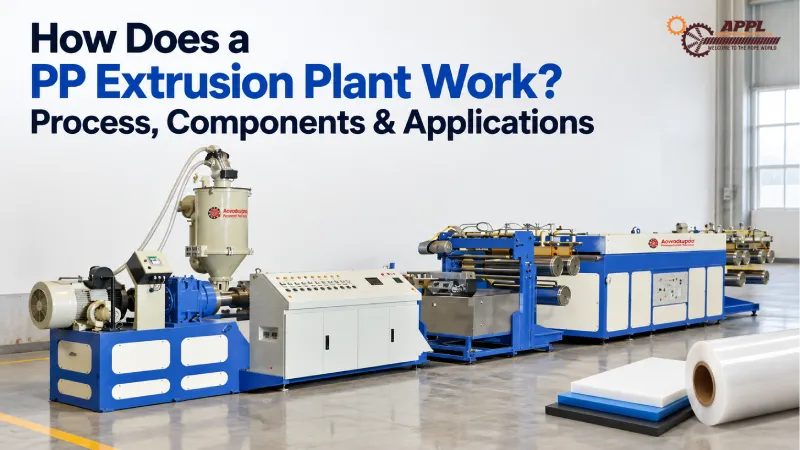
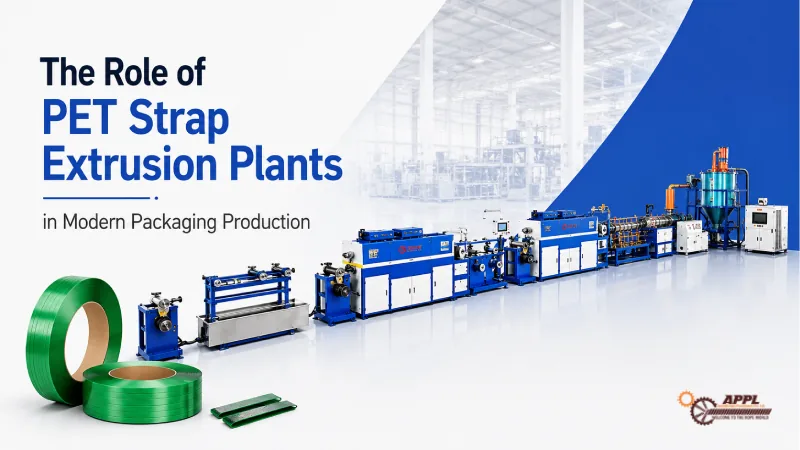
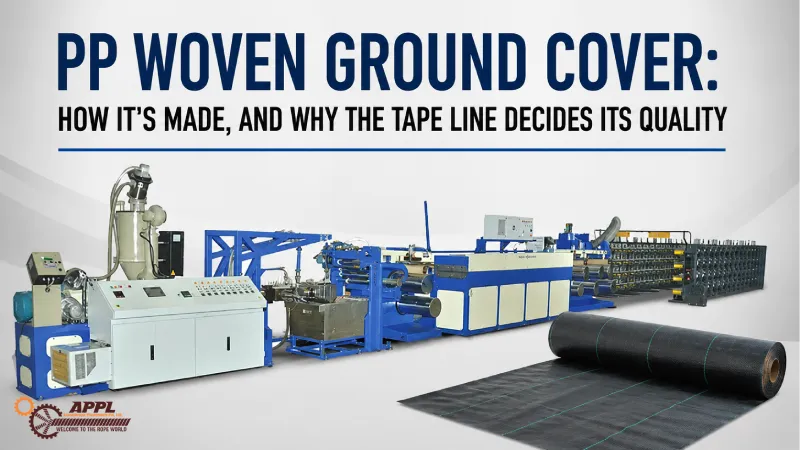
A PP raffia tape stretching line converts polypropylene granules into oriented tape wound onto bobbins for weaving.
1. Extrusion
Polypropylene granules are combined with colour and UV-stabilizer masterbatch. The material is melted, homogenized, and passed through a flat die to create a thin film. Stable processing and consistent die performance are important for producing uniform film thickness.
2. Film Quenching
The hot film is rapidly cooled using a chill roll or water quench system. Controlled cooling helps prepare the film for the next stages.
3. Slitting
The cooled film is divided into narrow tapes using precision blades. Proper slitting helps maintain tape width and clean edges.
4. Stretching and Orientation
This is the central stage of the PP raffia tape stretching line. The tapes are heated and drawn between rollers operating at different speeds. The source information describes typical draw ratios in the range of approximately 1:5 to 1:7. This orientation develops the tape's strength and reduces elongation.
5. Annealing and Heat Setting
After stretching, the tape passes through a heated zone where the orientation is stabilized. This helps the tape retain its properties during subsequent use.
6. Winding
Automatic winders collect the finished tapes onto bobbins at controlled tension. These bobbins can then be supplied to circular or flat weaving looms.After weaving, the ground cover can go through finishing operations such as edge treatment, guide-line printing, cutting, and rolling.
What Should Manufacturers Look for in a Tape Line?
When selecting a PP raffia tape stretching line, manufacturers should evaluate the characteristics that directly affect production and finished-product quality.
Important considerations include:
- Tape consistency in thickness, width, and denier.
- Tensile strength suitable for the intended product.
- Denier flexibility for producing different woven-PP products.
- Production output and energy efficiency for efficient operation.
- Stable running with low waste and tape breakage.
- Automation and technical support for consistent production.
A properly specified line can also provide flexibility beyond ground cover production. The source information notes that suitable lines may produce finer tapes for ground cover as well as heavier tapes for sacks, FIBC, and tarpaulins.
Why Choose Us
At Aawadkrupa Plastomech Pvt. Ltd., we focus on engineering and exporting PP extrusion and tape-stretching plants for woven polypropylene production. Our approach is cantered on producing strong and uniform tape suitable for demanding applications such as PP woven ground cover. We understand that tape quality affects weaving performance, finished-product consistency, and the ability to serve different woven-PP markets. Our solutions are designed around practical production requirements, including tape consistency, flexibility, stable operation, and efficient manufacturing. With our focus on machinery engineering and customer requirements, we aim to support manufacturers looking to establish or expand their woven polypropylene production capabilities.
Conclusion
PP woven ground cover may look simply, but its performance begins with the quality of the tape used to weave it. The PP raffia tape stretching line plays a central role by controlling film formation, tape dimensions, orientation, strength, and stability before the material reaches the loom. For manufacturers, choosing the right line can directly influence product quality, production consistency, and the ability to serve multiple woven-PP markets. Aawadkrupa Plastomech Pvt. Ltd. provides extrusion and tape-stretching solutions built around these production requirements. A well-planned tape line gives manufacturers a stronger foundation for producing dependable ground cover and other woven polypropylene products for different applications.
Planning to manufacture or expand PP woven ground cover production? Contact Aawadkrupa Plastomech Pvt. Ltd. at +91 9510186014 or email info@akiropes.com to discuss the right PP raffia tape stretching line for your plant.
Frequently Asked Questions
What is PP woven ground cover and what are its uses?
PP woven ground cover is a textile made from narrow polypropylene tapes, used for weed control, moisture management, and drainage in agriculture, horticulture, and landscaping. It's commonly found in nurseries, orchards, vineyards, and under various landscape applications.
How does the quality of the tape affect PP woven ground cover?
The quality of the polypropylene tape is crucial, as it influences the ground cover's strength, dimensional stability, and outdoor performance. Properly oriented and UV-stabilized tapes ensure better durability and functionality in various environmental conditions.
What is a PP raffia tape stretching line?
A PP raffia tape stretching line is a production system that converts polypropylene granules into oriented tapes used for weaving ground cover. It involves several key processes including extrusion, stretching, and annealing, which enhance the tape's strength and performance.
Why is UV stability important in PP woven ground cover?
UV stability is important because it protects the ground cover from degradation caused by sunlight exposure. Incorporating UV stabilizers during the tape production process ensures that the material maintains its integrity and performance over time.
What should manufacturers look for in a tape stretching line?
Manufacturers should consider factors such as tape consistency, tensile strength, denier flexibility, production output, and energy efficiency. A well-specified line enables stable operation and helps produce high-quality tapes suitable for various woven polypropylene applications.
Summarize with AI: