

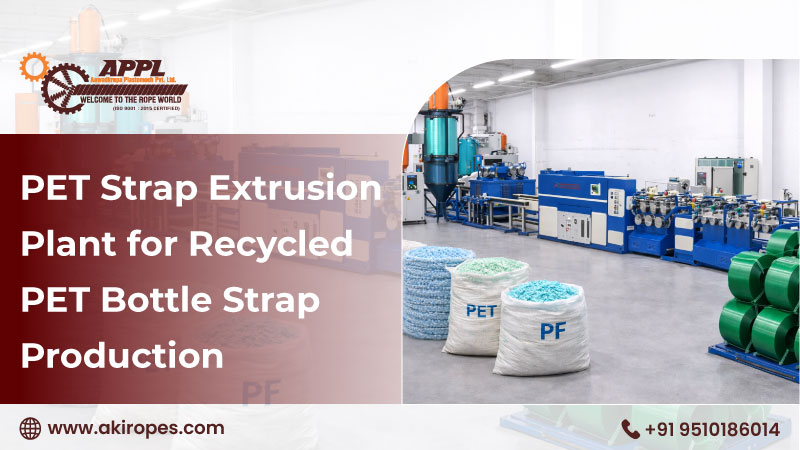
What if your waste PET bottles could become a steady source of profit while also cutting material costs and supporting sustainability. That is not a distant idea. It is a working production model today. Many packaging and recycling businesses now convert PET waste into strong, reliable strapping with a modern Pet Strap Extrusion Plant. This single investment changes how yu look at scrap. It turns discarded bottles into a valuable product used in logistics, bundling, and heavy-duty packaging. The Growing Need for PET Straps from Recycled Bottles
Industries ship more goods than ever. Every load needs safe bundling. Steel straps cost more and add weight. PET straps solve both problems. They offer high tensile strength, stable performance, and easier handling. When produced from recycled bottles, they also reduce raw material cost. A modern Pet Strap Extrusion Plant converts washed PET flakes into uniform straps with controlled width, thickness, and strength.
This process supports circular manufacturing. It also cuts dependence on virgin plastic. For many plants, raw material cost drops by a large margin once recycled input becomes stable. Recycled PET straps now serve packaging for bricks, cotton bales, cartons, timber, and heavy boxes. Demand keeps rising because logistics teams want lighter, safer, and more cost-effective strapping.
How a PET Strap Extrusion Plant Works
The process starts with clean PET flakes. These flakes come from shredded and washed bottles. They move into a drying and crystallizing system to remove moisture. This step matters because moisture affects melt quality and final strap strength.
Next, the material enters the extruder. Inside the Pet Strap Extrusion Plant, the screw melts and homogenizes the PET. The melt then passes through a die to form flat strap profiles. A cooling tank stabilizes shape. After that, a stretching and annealing section improves molecular orientation. This step increases tensile strength and reduces elongation during use.
Finally, the strap goes through embossing, thickness control, and winding. The result is a smooth, consistent coil ready for packing or direct use. Each stage plays a role in final quality. That is why equipment design and control systems matter more than many buyers expect.
Why Recycled PET Is a Smart Business Choice
Recycled PET offers three clear advantages.
- First, it cuts raw material cost. PET flakes from bottles cost far less than virgin resin. Over a year, this difference changes your margins in a big way.
- Second, it supports sustainability goals. Many brands now prefer packaging partners who use recycled materials. This helps you win contracts and meet compliance needs.
- Third, supply stays stable in many regions. Bottle waste is available in large volumes. With the right sorting and washing partners, your Pet Strap Extrusion Plant can run with steady input.
Quality does not suffer when the process is set correctly. With proper drying, filtration, and extrusion control, recycled PET straps meet the same performance needs as straps made from new resin.
Key Components That Define Plant Performance
A strong production line depends on smart engineering. When you compare options from different Pet Strap Extrusion Plant Manufacturers, focus on these systems.
- Extruder and Screw Design: The screw must handle PET smoothly. Good design improves melting, mixing, and output stability. It also reduces energy use per kg.
- Filtration and Melt Quality Control: Fine filters remove contaminants from recycled flakes. This protects the die and improves surface finish.
- Die and Calibration System: This controls width and thickness. Stable dimensions reduce strap breakage and improve sealing during use.
- Stretching and Annealing Section: This is where strength develops. Controlled heating and stretching align polymer chains and lock in performance.
- Haul-off and Winding System: Stable tension avoids uneven coils and edge damage. Good winding saves storage space and improves customer handling.
A complete Pet Strap Extrusion Plant balances all these parts. If one section underperforms, the whole line suffers.
Output Quality That Matches Industrial Needs
Buyers of PET straps care about three things. Tensile strength. Consistent width and thickness. Reliable elongation behaviour.
Modern lines from experienced Pet Strap Extrusion Plant Manufacturers achieve this with closed-loop control systems. Sensors track temperature, pressure, and speed. Adjustments happen in real time. This keeps each meter of strap close to target values. Embossing also plays a role. It improves grip during strapping and reduces slippage. Surface finish and edge quality affect how the strap behaves in high-speed strapping machines. When quality stays stable, customers stay loyal. That is where long-term business value grows.
Production Capacity and Scalability
Different businesses start at different scales. Some begin with one line. Others plan multi-line plants from day one. A well-designed Pet Strap Extrusion Plant allows upgrades. You can add output, increase line speed, or install wider strap options later. This protects your initial investment.
Energy efficiency also matters at higher volumes. Better heaters, motors, and process control reduce cost per ton. Over years of operation, these savings become large. This is why working with reliable Pet Strap Extrusion Plant Manufacturers is not just a purchase decision. It is a production strategy.
Maintenance, Training, and Daily Operation
Stable output depends on routine care. Good plants offer easy access to filters, screws, and dies. This cuts downtime during cleaning or changeovers. Operator training also matters. When your team understands temperature control, moisture management, and tension settings, scrap rates fall fast. Aawadkrupa Plastomech Pvt. Ltd. focuses on user-friendly systems. This reduces dependence on outside technicians and keeps your line running with your own staff.
Market Opportunities for PET Strap Producers
The customer base keeps expanding. Logistics centres, brick plants, textile units, and export packaging companies all need strapping. PET straps replace steel in many cases because they are safer to handle and do not rust. They also cost less to ship due to lower weight. With a strong Pet Strap Extrusion Plant, you can serve local markets and supply regional distributors. Many producers build long-term contracts with packaging users who need steady volume. As more companies move toward recycled materials, demand for PET straps made from bottle waste continues to rise.
Choosing the Right Technology Partner
Not all machines perform the same. Design details, control systems, and after-sales support make a real difference. Aawadkrupa Plastomech Pvt. Ltd. works in this field with a clear focus on performance, stability, and practical operation. The company supplies complete solutions, from extrusion to winding, with systems tuned for recycled PET processing.
When you compare Pet Strap Extrusion Plant Manufacturers, look beyond price. Look at installation support, spare availability, and process guidance. These factors decide how fast your plant reaches full output and how stable it stays over time. Aawadkrupa Plastomech Pvt. Ltd. has built its reputation by focusing on real production needs, not just machine specifications.
Why Choose Us
Aawadkrupa Plastomech Pvt. Ltd. stands out because the company designs each Pet Strap Extrusion Plant with a clear focus on recycled PET performance, stable output, and simple operation. The team understands how small process details affect strap strength and surface quality. Support does not end after installation. You get guidance on material preparation, process settings, and routine maintenance. This practical approach helps your plant reach target capacity faster and stay there. With Aawadkrupa Plastomech Pvt. Ltd., you work with a partner that thinks in terms of daily production, long-term reliability, and real business results, not just machine delivery.
Conclusion
A Pet Strap Extrusion Plant for recycled PET bottle strap production gives you a strong mix of cost control, steady demand, and sustainable manufacturing. It turns waste into a high-use industrial product with clear market value. With the right equipment, quality stays consistent and production stays predictable. Choosing experienced Pet Strap Extrusion Plant Manufacturers shapes your success for years, not months. Aawadkrupa Plastomech Pvt. Ltd. offers systems built for real-world conditions and long-term operation. If you want to build a reliable strap production business with recycled PET, this technology gives you a practical and profitable path forward.
Looking for a reliable PET Strap Extrusion Plant for recycled bottle straps. Call +919510186014 or email info@akiropes.com to discuss your production goals and plant setup today.
Key Takeaways
- Recycled PET straps reduce raw material cost and support sustainable manufacturing.
- A modern Pet Strap Extrusion Plant controls strength, thickness, and surface quality.
- Process stability depends on drying, filtration, and stretching systems.
- Choosing the right Pet Strap Extrusion Plant Manufacturers affects long-term output and support.
- Aawadkrupa Plastomech Pvt. Ltd. focuses on practical, production-ready solutions.
FAQs
Can recycled PET really produce strong straps?
Yes. With proper drying, filtration, and stretching, recycled PET straps meet industrial strength and performance needs.
What raw material does the plant use?
The plant uses clean, washed PET flakes made from waste bottles as the main input material.
Is the production process energy efficient?
Modern lines use controlled heating and efficient drives to keep energy use per kg within practical limits.
How much space does a typical plant need?
Space depends on output capacity, but layouts can be planned to fit both small and large production floors.
Does Aawadkrupa Plastomech Pvt. Ltd. provide support after installation?
Yes. The company offers process guidance, training, and technical support to keep your line running smoothly.